Process Managers
View SourceProcess managers coordinate long-running business processes that span multiple aggregates. They react to events and dispatch commands to drive workflows forward.
The reference material is explicit that a process manager is not a saga,
and these guides follow it: there is no saga module in evoq. What a process
manager can do on a failure is compensate, through its own compensate/2.
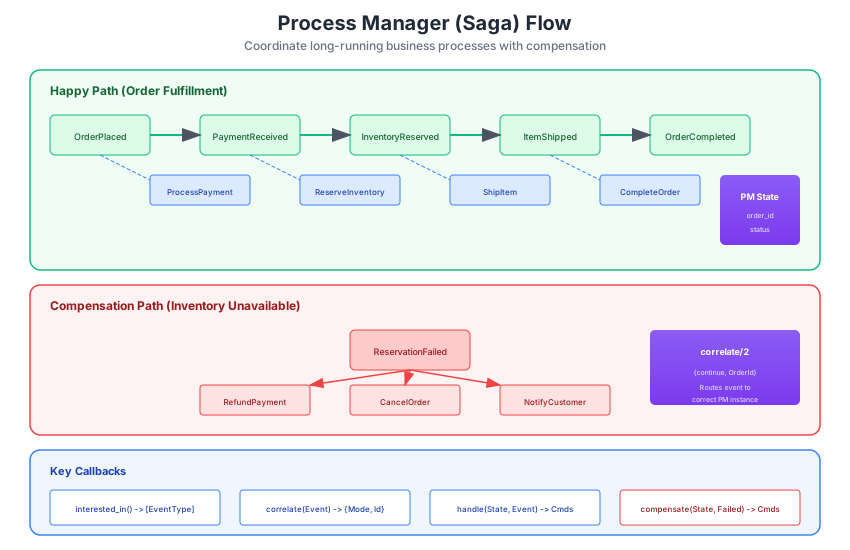
When to Use Process Managers
Use process managers when:
- A business process spans multiple aggregates
- You need to coordinate a sequence of operations
- Failures require compensation (rollback)
- The process has state that persists across events
Examples:
- Order fulfillment (payment → inventory → shipping)
- User onboarding (account → profile → welcome email)
- Money transfer (debit source → credit destination)
Basic Process Manager
-module(order_fulfillment_pm).
-behaviour(evoq_process_manager).

-export([interested_in/0, correlate/2, handle/3, apply/2]).

%% Events this process manager reacts to
interested_in() ->
    [<<"OrderPlaced">>, <<"PaymentReceived">>, <<"InventoryReserved">>, <<"ItemShipped">>].

%% Route events to the correct process instance. The last event of the
%% process stops it; anything else is false, so correlate/2 never raises.
correlate(#{event_type := <<"ItemShipped">>, data := #{order_id := OrderId}}, _Metadata) ->
    {stop, OrderId};
correlate(#{data := #{order_id := OrderId}}, _Metadata) ->
    {continue, OrderId};
correlate(_Event, _Metadata) ->
    false.

%% React to events by dispatching commands
handle(State, #{event_type := <<"OrderPlaced">>} = Event, _Meta) ->
    OrderId = maps:get(order_id, maps:get(data, Event)),
    Amount = maps:get(amount, maps:get(data, Event)),

    %% Dispatch command to payment aggregate
    Cmd = evoq_command:new(process_payment, payment, OrderId, #{amount => Amount}),
    {ok, State#{status => awaiting_payment}, [Cmd]};

handle(State, #{event_type := <<"PaymentReceived">>}, _Meta) ->
    OrderId = maps:get(order_id, State),

    %% Dispatch command to inventory aggregate
    Cmd = evoq_command:new(reserve_inventory, inventory, OrderId, #{}),
    {ok, State#{status => awaiting_inventory}, [Cmd]};

handle(State, #{event_type := <<"InventoryReserved">>}, _Meta) ->
    OrderId = maps:get(order_id, State),

    %% Dispatch command to shipping aggregate
    Cmd = evoq_command:new(ship_item, shipping, OrderId, #{}),
    {ok, State#{status => awaiting_shipment}, [Cmd]};

handle(State, #{event_type := <<"ItemShipped">>}, _Meta) ->
    %% Process complete
    {ok, State#{status => completed}}.

%% Update process state from events
apply(State, #{event_type := <<"OrderPlaced">>, data := Data}) ->
    State#{
        order_id => maps:get(order_id, Data),
        customer_id => maps:get(customer_id, Data),
        items => maps:get(items, Data),
        status => started
    };
apply(State, _Event) ->
    State.
Required Callbacks
interested_in/0
Declare which event types this process manager reacts to:
-spec interested_in() -> [EventType :: binary()].

interested_in() ->
    [<<"OrderPlaced">>, <<"PaymentFailed">>, <<"InventoryUnavailable">>].
The store subscription routes every event of these types to the process manager, whether or not an event handler consumes them too. A process manager started after the store subscription gets the history of its types first, to it alone, and then the live events, each once and in store order. History the node had consumed before it went down arrives as replay (see below).
correlate/2
Route events to the correct process instance:
-spec correlate(Event :: map(), Metadata :: map()) ->
    {start, ProcessId :: binary()} |
    {continue, ProcessId :: binary()} |
    {stop, ProcessId :: binary()} |
    false.

%% Start a new process
correlate(#{event_type := <<"OrderPlaced">>, data := #{order_id := OrderId}}, _Meta) ->
    {start, OrderId};

%% Continue existing process
correlate(#{event_type := <<"PaymentReceived">>, data := #{order_id := OrderId}}, _Meta) ->
    {continue, OrderId};

%% Stop the process
correlate(#{event_type := <<"OrderCancelled">>, data := #{order_id := OrderId}}, _Meta) ->
    {stop, OrderId};

%% Ignore event (no matching process)
correlate(_, _) ->
    false.
A process instance belongs to its process manager: the ProcessId names an instance of THIS process manager only. Two process managers that correlate on the same id (both on an order id, say) each get their own instance and their own state. Before 1.26.0 instances were found by event type and id alone, so they could reach each other's instance.
Every event of a PM's types is delivered to it as long as some event handler also consumes that type: the store subscription routes a type only when a handler holds it (evoq #2). A type only a process manager declares is not delivered yet; until that is fixed, give such a type a handler.
handle/3
React to events and optionally dispatch commands:
-spec handle(State :: term(), Event :: map(), Metadata :: map()) ->
    {ok, NewState :: term()} |
    {ok, NewState :: term(), Commands :: [map()]}.

%% Just update state
handle(State, #{event_type := <<"OrderPlaced">>}, _Meta) ->
    {ok, State#{started_at => erlang:system_time()}};

%% Update state and dispatch commands
handle(State, #{event_type := <<"PaymentReceived">>, data := #{order_id := OrderId}}, _Meta) ->
    Cmd1 = evoq_command:new(reserve_inventory, inventory, OrderId, #{}),
    Cmd2 = evoq_command:new(notify_warehouse, warehouse, OrderId, #{}),
    {ok, State#{payment_received => true}, [Cmd1, Cmd2]}.
apply/2
Update process state from events. The runtime calls handle/3 first, then
apply/2 on the state handle/3 returned, so handle/3 sees the state as it
was before this event:
-spec apply(State :: term(), Event :: map()) -> NewState :: term().

apply(State, #{event_type := <<"OrderPlaced">>, data := Data}) ->
    State#{
        order_id => maps:get(order_id, Data),
        total => maps:get(total, Data)
    };
apply(State, #{event_type := <<"PaymentReceived">>, data := #{amount := Amount}}) ->
    State#{paid_amount => Amount}.
Compensation (Rollback)
When a command the process manager dispatched fails, the instance stops
dispatching the rest of that batch, runs the process manager's compensate/2
with the failed command, and dispatches what it returns, in order.
A process manager that exports compensate/2 also gets the commands it did
dispatch recorded in its state (executed_commands, most recent first, read
with evoq_pm_compensation:get_executed_commands/1), cleared once the
compensation has run. It is in memory only and does not survive a restart -
keep anything a compensation must know across a restart in your own state,
rebuilt in apply/2.
-module(money_transfer_pm).
-behaviour(evoq_process_manager).

-include_lib("evoq/include/evoq.hrl").

-export([interested_in/0, correlate/2, handle/3, apply/2, compensate/2]).

interested_in() ->
    [<<"TransferInitiated">>, <<"SourceDebited">>, <<"DestinationCreditFailed">>].

correlate(#{data := #{transfer_id := TransferId}}, _Meta) ->
    {continue, TransferId};
correlate(_Event, _Meta) ->
    false.

handle(State, #{event_type := <<"TransferInitiated">>, data := Data}, _Meta) ->
    %% Step 1: Debit source account, keeping what step 2 needs in the
    %% process's own state.
    Cmd = evoq_command:new(debit, account, maps:get(source_id, Data),
                           #{amount => maps:get(amount, Data)}),
    {ok, State#{status => debiting_source,
                source_id => maps:get(source_id, Data),
                dest_id => maps:get(dest_id, Data),
                amount => maps:get(amount, Data)}, [Cmd]};

handle(State, #{event_type := <<"SourceDebited">>}, _Meta) ->
    %% Step 2: Credit destination account
    Cmd = evoq_command:new(credit, account, maps:get(dest_id, State),
                           #{amount => maps:get(amount, State)}),
    {ok, State#{status => crediting_dest}, [Cmd]};

handle(State, #{event_type := <<"DestinationCreditFailed">>}, _Meta) ->
    %% Credit failed - need to compensate
    {ok, State#{status => compensating}}.

apply(State, _Event) ->
    State.

%% Compensation callback. The failed command arrives as the evoq_command
%% record the process manager returned - it is a #evoq_command{}, not a map.
-spec compensate(State :: term(), FailedCommand :: #evoq_command{}) ->
    {ok, CompensatingCommands :: [#evoq_command{}]} | skip.

compensate(#{source_id := SourceId, amount := Amount},
           #evoq_command{command_type = credit}) ->
    %% Credit failed, refund the source account
    RefundCmd = evoq_command:new(credit, account, SourceId, #{
        amount => Amount,
        reason => <<"transfer_failed">>
    }),
    {ok, [RefundCmd]};

compensate(_, _) ->
    skip.
A Deadline of Your Own: handle_info/2
A process manager that has a deadline to keep (a clock that flags a player who ran out of time, a bid that expires) schedules a message to itself, and until this callback existed the instance dropped it: the deadline was scheduled and never arrived. Declare the optional callback and the message lands:
-module(game_clock_pm).
-behaviour(evoq_process_manager).

-export([interested_in/0, correlate/2, handle/3, apply/2, handle_info/2]).

interested_in() ->
    [<<"game_started_v1">>].

correlate(#{data := #{game_id := GameId}}, _Meta) ->
    {continue, GameId};
correlate(_Event, _Meta) ->
    false.

apply(State, _Event) ->
    State.

handle(State, #{event_type := <<"game_started_v1">>, data := Data}, _Meta) ->
    %% What is left on the mover's clock, from the event, not from a read model.
    erlang:send_after(maps:get(mover_ms, Data), self(), {deadline, maps:get(mover, Data)}),
    {ok, State#{mover => maps:get(mover, Data)}};

handle(State, _Event, _Meta) ->
    {ok, State}.

handle_info({deadline, Player}, State) ->
    %% Commands returned here are dispatched exactly as handle/3's are.
    {noreply, State#{flagged => Player}, [flag_clock_cmd(Player)]};
handle_info(Other, State) ->
    %% Keep it total: an unmatched message must not take the instance down.
    {noreply, State#{last_ignored => Other}}.

flag_clock_cmd(Player) ->
    evoq_command:new(flag_clock, clock, Player, #{}).
The return shape is {noreply, NewState}, {noreply, NewState, Commands}
or {stop, Reason, NewState}. Three things about it:
- The atom
timeoutis evoq's own idle timer and is never forwarded. It is matched before the callback, so pick any other tag for your own timer. - A PM without
handle_info/2that is sent a message logs a warning naming itself and the message, rather than losing it quietly. Silence is what hid this gap for so long. - Check
replayingbefore scheduling. Replay runshandle/3again, and asend_afterthere schedules a second timer. The deadline itself must still be rebuilt from the events' own timestamps, and the resulting command must be safe to arrive twice: an instance whoseapply/2state says the game already ended ignores a deadline that fires again.
Restarts and Replay
Process manager instances live in memory, so after a restart they are
rebuilt by replaying history: every event the node had already consumed
before it went down comes around again with replaying => true in the
metadata.
For replay, handle/3 and apply/2 both run, so an instance rebuilds
exactly the state it had, including state kept in handle/3 as in the
state machine pattern below. The commands handle/3 returns are not
dispatched: the process manager already reacted to that event, and
dispatching again would re-issue its whole history on every restart.
Events appended while the node was down were never delivered, arrive
without replaying, and are handled and dispatched normally.
If handle/3 has a side effect of its own rather than returning a
command, check maps:get(replaying, Metadata, false) before performing
it. After a crash, up to 199 events delivered since the last acknowledged
checkpoint arrive as new again, so commands should still be idempotent.
State Machine Pattern
Process managers naturally model state machines:
-module(order_state_machine_pm).
-behaviour(evoq_process_manager).

-export([interested_in/0, correlate/2, handle/3, apply/2]).

interested_in() ->
    [<<"OrderPlaced">>, <<"PaymentReceived">>, <<"PaymentFailed">>, <<"ItemShipped">>].

correlate(#{data := #{order_id := OrderId}}, _Meta) ->
    {continue, OrderId};
correlate(_Event, _Meta) ->
    false.

apply(State, _Event) ->
    State.

%% State transitions
handle(#{status := new} = State, #{event_type := <<"OrderPlaced">>}, _) ->
    {ok, State#{status => awaiting_payment}, [process_payment_cmd(State)]};

handle(#{status := awaiting_payment} = State, #{event_type := <<"PaymentReceived">>}, _) ->
    {ok, State#{status => awaiting_shipment}, [ship_order_cmd(State)]};

handle(#{status := awaiting_payment} = State, #{event_type := <<"PaymentFailed">>}, _) ->
    {ok, State#{status => cancelled}, [notify_customer_cmd(State)]};

handle(#{status := awaiting_shipment} = State, #{event_type := <<"ItemShipped">>}, _) ->
    {ok, State#{status => completed}};

%% Invalid transition - ignore
handle(State, _Event, _Meta) ->
    {ok, State}.

%% The commands this manager issues, each addressed by the order in its own
%% state.
process_payment_cmd(#{order_id := OrderId}) ->
    evoq_command:new(process_payment, payment, OrderId, #{}).

ship_order_cmd(#{order_id := OrderId}) ->
    evoq_command:new(ship_item, shipping, OrderId, #{}).

notify_customer_cmd(#{order_id := OrderId}) ->
    evoq_command:new(notify_customer, notification, OrderId, #{}).
Instance Lifetime
An instance lives in memory until a {stop, Id} event ends it. The idle
timer only logs; it is not a timeout callback, and timeout is never
forwarded to your handle_info/2 (see "A Deadline of Your Own"). A process
that never reaches a {stop, Id} keeps one process per id for the life of
the node, so give every process a terminal event, and design ones that can
stall so that something (a scheduled message to your own handle_info/2,
another aggregate's event) produces it.
{start, Id}always starts a new instance, even when one exists for that id; use{continue, Id}unless the event genuinely begins a new process. The earlier instance keeps running, and receives that id's events again once the newer one stops.{stop, Id}hands the event to the running instance and stops it. When no instance exists for the id, the event is dropped: a process whose first event would be a stop never sees it.- Instances are node-local. With the same process manager on several
nodes, each node routes an event to its own instance for the id, or
starts one, and a
{stop, Id}stops only that node's instance; no node hands an event to another node's instance (evoq #10). Each node that consumes the store therefore runs its own instance of every process: if a process must run once in the cluster, run its process manager on one node. - A crash in one process manager's
correlate/2,handle/3orapply/2stays its own: the router logsevoq_process_manager_failed, emits[evoq, process_manager, exception], keeps the event as a dead letter of that process manager, and goes on routing it to the others. An instance that crashed is gone; the next event for its id starts a new one, which does not have the old one's state. A router that restarts anyway routes to every process manager registered before (evoq #9). A catch-allcorrelate(_, _) -> falseis still the way to say an event is not yours, rather than leaving a dead letter for it.
Correlation Strategies
By Entity ID
Most common - route by the main entity:
correlate(#{data := #{order_id := OrderId}}, _) ->
    {continue, OrderId}.
By Correlation ID
Use metadata for cross-aggregate correlation:
correlate(_Event, #{correlation_id := CorrelationId}) ->
    {continue, CorrelationId}.
Composite Key
When multiple entities involved:
correlate(#{data := #{source := Src, dest := Dst}}, _) ->
    {continue, <<"transfer:", Src/binary, ":", Dst/binary>>}.
Testing Process Managers
Test the state machine in isolation:
-module(order_pm_tests).
-include_lib("eunit/include/eunit.hrl").

%% The events the process manager reacts to, as the store delivers them.
order_placed_event() ->
    #{event_type => <<"OrderPlaced">>,
      data => #{order_id => <<"order-1">>, total => 100}}.

payment_received_event() ->
    #{event_type => <<"PaymentReceived">>,
      data => #{order_id => <<"order-1">>, amount => 100}}.

item_shipped_event() ->
    #{event_type => <<"ItemShipped">>,
      data => #{order_id => <<"order-1">>}}.

full_workflow_test() ->
    %% Initial state
    State0 = #{},

    %% Order placed
    %% The runtime's order: handle/3 on the state so far, then apply/2 on
    %% the state it returned.
    {start, OrderId} = order_pm:correlate(order_placed_event(), #{}),
    {ok, Handled1, [PaymentCmd]} = order_pm:handle(State0, order_placed_event(), #{}),
    State2 = order_pm:apply(Handled1, order_placed_event()),

    ?assertEqual(awaiting_payment, maps:get(status, State2)),
    ?assertEqual(process_payment, maps:get(command_type, PaymentCmd)),

    %% Payment received
    {ok, Handled2, [ShipCmd]} = order_pm:handle(State2, payment_received_event(), #{}),
    State4 = order_pm:apply(Handled2, payment_received_event()),

    ?assertEqual(awaiting_shipment, maps:get(status, State4)),
    ?assertEqual(ship_item, maps:get(command_type, ShipCmd)),

    %% Item shipped
    {ok, Handled3} = order_pm:handle(State4, item_shipped_event(), #{}),
    State6 = order_pm:apply(Handled3, item_shipped_event()),

    ?assertEqual(completed, maps:get(status, State6)).
Telemetry Events
Process managers emit telemetry:
| Event | Measurements | Metadata |
|---|---|---|
[evoq, process_manager, start] | (none) | pm_module, process_id |
[evoq, process_manager, stop] | (none) | pm_module, process_id |
[evoq, process_manager, command] | (none) | pm_module, process_id, command_type |
[evoq, process_manager, compensate] | command_count | pm_module, process_id |
[evoq, process_manager, exception] | (none) | pm_module, event_type, error |
Best Practices
1. Keep Processes Short-Lived
Long-running processes accumulate state and risk:
- Design for completion in minutes/hours, not days
- Split long workflows into smaller processes
- Give every process a terminal event that correlates as
{stop, Id}(see Instance Lifetime)
2. Make Steps Idempotent
Commands may be dispatched multiple times:
handle(State, Event, _Meta) ->
    case already_dispatched(Event, State) of
        true -> {ok, State};
        false ->
            Cmd = create_command(Event),
            {ok, mark_dispatched(Event, State), [Cmd]}
    end.
3. Handle All Failure Modes
interested_in() ->
    [
        %% Happy path
        <<"OrderPlaced">>, <<"PaymentReceived">>, <<"ItemShipped">>,
        %% Failure cases
        <<"PaymentFailed">>, <<"InventoryUnavailable">>, <<"ShippingFailed">>
    ].
4. Log State Transitions
handle(State, Event, _Meta) ->
    OldStatus = maps:get(status, State),
    {ok, NewState, Cmds} = do_handle(State, Event),
    NewStatus = maps:get(status, NewState),

    logger:info("Process ~p: ~p -> ~p on ~p",
        [maps:get(process_id, State), OldStatus, NewStatus, maps:get(event_type, Event)]),

    {ok, NewState, Cmds}.
Next Steps
- Projections - Build read models
- Event Handlers - Side effects
- Architecture - System overview