Projections
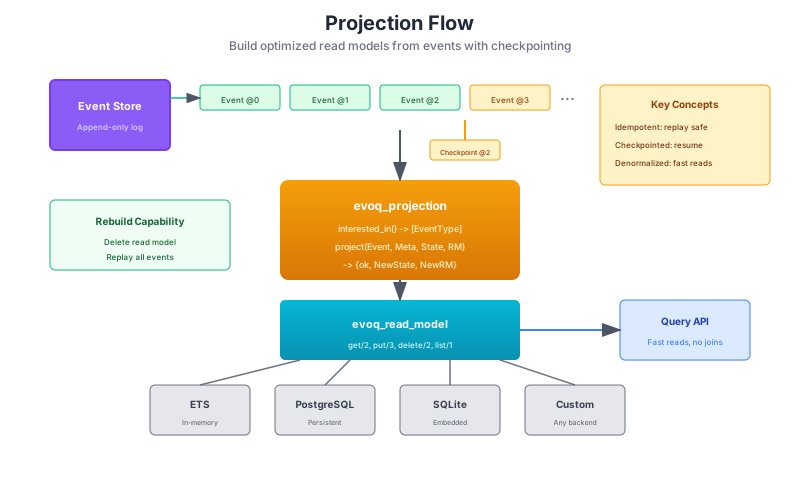
View SourceProjections build read models from events. They transform the event stream into optimized views for queries, enabling fast reads without impacting write performance.
When to Use Projections
Use projections for:
- Query-optimized views - Denormalized data for fast reads
- Aggregated data - Counts, sums, statistics
- Cross-aggregate views - Data from multiple aggregates
- Search indexes - Full-text search, filtering
The key insight: read models can be rebuilt by replaying events.
Understanding Event Envelope Structure
IMPORTANT: project/4 takes the event as its first argument and the
delivered metadata as its second. The event is a flat map:
#{
    event_type => <<"order_placed_v1">>,  %% Event type (binary)
    data => #{                             %% ← YOUR BUSINESS EVENT PAYLOAD
        order_id => <<"ord-123">>,
        customer_id => <<"cust-456">>,
        total => 99.99,
        items => [<<"item-1">>, <<"item-2">>]
    },
    tags => [<<"tenant:acme">>],
    timestamp => 1703001234567             %% ← read the time from here
}.
and the metadata is the routing envelope:
#{
    stream_id => <<"order-018f6a7b8c9d4e5f60718293a4b5c6d9">>,      %% the stream the event was appended to
    version => 7,                          %% the subscription's per-boot counter
    stream_version => 3,                   %% the event's version in its stream
    global_position => 412,                %% its index in the store's global log
    event_id => <<"01J8...">>,
    correlation_id => <<"req-abc">>,       %% lineage, see evoq_lineage
    causation_id => <<"cmd-xyz">>
}.
Key fields:
event_type- Binary identifying the event typedata- Your business event payload (extract this)metadata- Cross-cutting metadata (correlation_id, causation_id, etc.)tags- Optional tags for cross-stream queries
The second parameter (Metadata) is the envelope metadata, duplicated for convenience.
See Event Envelope Guide for complete details.
Basic Projection
-module(order_summary_projection).
-behaviour(evoq_projection).

-export([interested_in/0, init/1, project/4]).

%% Events this projection processes
interested_in() ->
    [<<"OrderPlaced">>, <<"OrderShipped">>, <<"OrderCancelled">>].

%% Initialize projection with a read model backend
init(_Config) ->
    {ok, ReadModel} = evoq_read_model:new(evoq_read_model_ets, #{}),
    {ok, #{}, ReadModel}.

%% Project each event into the read model. The read model is keyed on the
%% order, which comes from the event's data: stream_id names the stream
%% (<<"order-018f6a7b8c9d4e5f60718293a4b5c6d9">>), not the order.
project(#{event_type := <<"OrderPlaced">>, data := Data} = Event, Metadata, State, ReadModel) ->
    OrderId = maps:get(order_id, Data),
    Summary = #{
        order_id => OrderId,
        customer_id => maps:get(customer_id, Data),
        total => maps:get(total, Data),
        items => maps:get(items, Data),
        status => placed,
        placed_at => maps:get(timestamp, Event)
    },
    {ok, NewRM} = evoq_read_model:put(OrderId, Summary, ReadModel),
    {ok, State, NewRM};

project(#{event_type := <<"OrderShipped">>, data := Data} = Event, Metadata, State, ReadModel) ->
    OrderId = maps:get(order_id, Data),
    case evoq_read_model:get(OrderId, ReadModel) of
        {ok, Summary} ->
            Updated = Summary#{
                status => shipped,
                tracking_number => maps:get(tracking_number, Data),
                shipped_at => maps:get(timestamp, Event)
            },
            {ok, NewRM} = evoq_read_model:put(OrderId, Updated, ReadModel),
            {ok, State, NewRM};
        {error, not_found} ->
            %% Order not found - skip
            {skip, State, ReadModel}
    end;

project(#{event_type := <<"OrderCancelled">>, data := Data} = Event, Metadata, State, ReadModel) ->
    OrderId = maps:get(order_id, Data),
    case evoq_read_model:get(OrderId, ReadModel) of
        {ok, Summary} ->
            Updated = Summary#{
                status => cancelled,
                cancelled_at => maps:get(timestamp, Event)
            },
            {ok, NewRM} = evoq_read_model:put(OrderId, Updated, ReadModel),
            {ok, State, NewRM};
        {error, not_found} ->
            {skip, State, ReadModel}
    end.
Required Callbacks
interested_in/0
Declare which event types to process:
-spec interested_in() -> [EventType :: binary()].

interested_in() ->
    [<<"UserRegistered">>, <<"ProfileUpdated">>, <<"UserDeactivated">>].
init/1
Initialize projection state and read model:
-spec init(Config :: map()) ->
    {ok, State :: term(), ReadModel :: term()} |
    {error, Reason :: term()}.

init(Config) ->
    %% Choose read model backend
    Backend = maps:get(backend, Config, evoq_read_model_ets),
    {ok, ReadModel} = evoq_read_model:new(Backend, Config),

    %% Initial state
    State = #{
        events_processed => 0,
        last_event_time => undefined
    },

    {ok, State, ReadModel}.
project/4
Transform an event into read model updates:
-spec project(Event :: map(), Metadata :: map(), State :: term(), ReadModel :: term()) ->
    {ok, NewState :: term(), NewReadModel :: term()} |
    {skip, State :: term(), ReadModel :: term()}.

project(Event, Metadata, State, ReadModel) ->
    %% Event: #{event_type => ..., data => ..., timestamp => ...}
    %% Metadata: #{stream_id => ..., version => ..., global_position => ...}

    %% Update read model
    {ok, NewRM} = update_read_model(Event, ReadModel),

    %% Update projection state
    NewState = State#{
        events_processed => maps:get(events_processed, State) + 1,
        last_event_time => maps:get(timestamp, Event)
    },

    {ok, NewState, NewRM}.
Read Model Backends
evoq provides a evoq_read_model abstraction with multiple backends:
ETS (In-Memory)
Fast, volatile storage. Good for caching and development.
init(_Config) ->
    {ok, RM} = evoq_read_model:new(evoq_read_model_ets, #{
        name => order_summaries
    }),
    {ok, #{}, RM}.
A persistent backend
evoq ships one read model backend, evoq_read_model_ets. SQL, DETS or an
external store is a backend you implement (next section) and start the
projection with:
init(Config) ->
    {ok, RM} = evoq_read_model:new(my_postgres_read_model, #{
        pool => my_pool,
        table => <<"order_summaries">>
    }),
    {ok, #{}, RM}.
Custom Backend
Implement the evoq_read_model behavior:
-module(my_custom_read_model).
-behaviour(evoq_read_model).

-export([init/1, get/2, put/3, delete/2, list/2, clear/1]).

%% A read model's state is whatever the store keeps; here, one map of
%% key to value.
init(Config) ->
    {ok, #{config => Config, data => #{}}}.

get(Key, #{data := Data}) ->
    case maps:find(Key, Data) of
        {ok, Value} -> {ok, Value};
        error -> {error, not_found}
    end.

put(Key, Value, #{data := Data} = State) ->
    {ok, State#{data => Data#{Key => Value}}}.

delete(Key, #{data := Data} = State) ->
    {ok, State#{data => maps:remove(Key, Data)}}.

%% Optional: without them a rebuild cannot clear, and list returns
%% {error, not_implemented}
list(Prefix, #{data := Data}) ->
    {ok, [{K, V} || {K, V} <- maps:to_list(Data), under(Prefix, K)]}.

clear(State) ->
    {ok, State#{data => #{}}}.

under(Prefix, Key) when is_binary(Prefix), is_binary(Key) ->
    binary:longest_common_prefix([Prefix, Key]) =:= byte_size(Prefix);
under(Prefix, Key) ->
    Prefix =:= Key.
Checkpointing
A projection records the position of the last event it projected, after every event, and skips any event at or below it as already projected. With no checkpoint store the position lives in the process and starts at -1 on every boot, which suits an in-memory read model rebuilt from the store on each start. A read model that survives a restart needs a checkpoint store that survives it too:
evoq_projection:start_link(order_summary_projection, #{},
                           #{checkpoint_store => my_checkpoint_store}).
The store implements evoq_checkpoint_store (load/1, save/2,
delete/1). evoq_checkpoint_store_ets keeps it in ETS, which does not
survive a node restart either.
A checkpoint store goes only with a durable read model, one whose module
exports durable() -> true. The checkpoint says "everything up to here is in
the read model"; kept across a restart next to rows that were not, it skips
the whole history and the read model comes back empty, without a word. So a
projection whose read model is not durable refuses a checkpoint store at
start:
{error, {checkpoint_outlives_read_model, order_summary_projection, evoq_read_model_ets}}evoq_read_model_ets answers false: its table belongs to the projection
process, so its rows go even when only the projection restarts, and the
node-wide evoq_checkpoint_store_ets outlives it. A read model without
durable/0 counts as not durable. A database-backed read model exports
durable() -> true.
The projection's own state (the State that init/1 returns) starts fresh
on every start as well. Keep in it nothing the checkpoint claims is
projected; that belongs in the read model.
A checkpoint save is a second write. The read model rows are written
first, then the checkpoint; a crash between the two leaves the read model
ahead of the checkpoint, so the last event may be projected again on the next
boot. Delivery is therefore at-least-once, not exactly-once: make
project/4 idempotent (put, do not increment a counter you read back
blindly) and expect the last event to repeat after a crash.
What the position is
Events from the store subscription carry global_position in their
metadata: the event's index in the store's global log. It is what the
checkpoint holds. A rebuild delivers the same global_position, so a
checkpoint saved by a rebuild and one saved from the live feed agree.
It names the same event in every boot as long as the store keeps its global
order. With reckon-db that means epoch_us stamps monotone in commit order
(no clock stepping back, no cluster nodes with differing clocks, no two
concurrent appends committing in the reverse order of their stamps) and no
event ever removed from the store (delete_stream, scavenge). Each
violation moves the positions after it, and the next restart skips or
repeats that many events.
Live positions are counted, not read from the store, so a second delivery of the same event (reckon-db may deliver one twice while its catch-up overlaps its live trigger) would move every later one. The store subscription drops an event whose id it consumed among the last 2000 before counting it. When its pre-subscribe ack fails, reckon-db's reconnect redelivers everything since the checkpoint the node had before it went down, so the window then reaches back to that checkpoint, however many events were appended in between.
What dropping duplicates does not cover is order. An event appended after catch-up's last read and before reckon-db arms its live trigger arrives through reckon-db's catch-up, possibly after an event appended just after arming. The two are numbered in the wrong order, and a crash between projecting them skips one and repeats the other on the next boot.
Before 1.25.0 the checkpoint held the subscription's per-boot counter,
version in the metadata, which restarts at 0 and counts only events that
have a handler. When the set of handlers changed between boots, a saved
checkpoint pointed at a different event: events appended while the node was
down were skipped, or projected events were projected again. version is
still there for anything that reads it; do not persist it. A checkpoint
saved by 1.24.x makes the first boot of 1.25.0 project part of the history
again (never skip): delete it before upgrading, or rebuild after.
Events handed to evoq_projection:notify/4 directly have no
global_position and are checkpointed on version. The two numbers are not
comparable, so a projection takes its events from one source, never both.
A projection that starts after the store subscription
A projection whose handler registers after the store subscription's catch-up (every projection in an application that boots after the one that owns the store) gets its history through backfill. The store subscription delivers the history of every type the projection registers, to that projection alone, in one pass over the store in global order, up to the position the subscription has reached. Until that pass has run, no live event of those types is routed to the projection, so each event arrives once, in store order, and the checkpoint never skips one.
It makes no difference whether another handler or process manager already consumes the type, or whether the projection registers during catch-up or after it. A registration that announces itself during catch-up is backfilled as soon as catch-up finishes.
A projection resuming at its checkpoint registers with that position, and its backfill starts there: the history it already holds is neither read again nor routed through the node's event router. A handler without a position gets its history from the start.
Each late registration scans the store once from where it starts. Registrations that arrive together are backfilled in the same pass, so an application that starts many projections at once pays for one scan, not one per projection.
Handling Projection Errors
A projection's project/4 can answer {error, Reason}. That is handled
exactly as an event handler's failure is: the optional on_error/4 decides
between retry, {retry, DelayMs}, skip, stop and
{dead_letter, Reason}, and without it the framework's default applies -
backoff, then dead letter after max_retries/0 attempts.
-spec on_error(term(), map(), #evoq_failure_context{}, term()) ->
    evoq_error_handler:error_action().

on_error(Reason, _Event, #evoq_failure_context{attempt_number = Attempt}, _State) ->
    case Attempt >= 3 of
        true -> {dead_letter, Reason};
        false -> {retry, 500}
    end.
What each action does to the checkpoint:
| Action | Checkpoint | Event comes back? |
|---|---|---|
retry, {retry, D} | unchanged | yes, immediately (or after D) |
skip | advanced | no - the projection said it does not want it |
{dead_letter, R} | advanced | no - stored for an operator (evoq_dead_letter:list/0) |
stop | unchanged | not automatically - see below |
on_error/4 is used as given: it replaces the default policy including its
retry cap, so an on_error/4 that always answers retry retries forever,
inside the projection's process, and {retry, D} sleeps there, holding up
every event behind it. Bound it yourself, with
FailureContext#evoq_failure_context.attempt_number or your own state.
The default (no on_error/4) is bounded: max_retries/0 attempts
(5 unless the module says otherwise) with evoq_retry_strategy's backoff,
which adds up to a few seconds per failing event before it is dead-lettered.
stop ends the process. The node's shared $all subscription has
already acknowledged past the event, so the feed will not hand it back. A
restart resumes from the projection's checkpoint, replaying what it missed
from the store; a projection with no checkpoint store has nothing to resume
from and needs evoq_projection:rebuild/1.
skip and {dead_letter, _} are logged with the event id and the position,
so a silent gap is not possible: a check that the read model is behind shows
up in the log.
A projection that comes up halted and behind
A projection never refuses to boot. It catches up at start in two passes -
one before it registers (so a long catch-up does not hold up the node's
event router), one after, from the position the first pass reached. The
second pass runs while registered, so the router waits on it for the length
of the second pass; that is bounded by what was appended while the first pass
ran, which is nothing at all for a projection whose first pass was short. If
either pass stops on an event - the stop action above, or a raise in
project/4, which is reported exactly like an {error, _} - the projection
comes up halted and behind:
- the checkpoint is the one the replay actually reached; nothing after it is projected, and the checkpoint never moves past it;
haltedin its state carries the reason, so every later event is answered{error, {halted, Reason}}instead of being projected (the event router logs that reply asevoq_handler_returned_error). Without this the next successful event would move the checkpoint past the event the projection refused, and the gap would be permanent and silent;- it says so once: a log line with
what => evoq_projection_halted_behind, theprojectionmodule and theerror, and the[evoq, projection, halted]telemetry event with the same metadata. (Once, not twice: a halt in the first pass skips the second, which would halt on the same event.)
Refusing to start would turn one poison event into a restart loop and, for a statically supervised projection, into a failed application boot. Coming up halted keeps the failure where the event is.
The way out is a rebuild, once the cause is fixed - repair the data, or ship the projection fix:
ok = evoq_projection:rebuild(ProjectionPid).That clears the read model, sets the checkpoint back to -1 and replays
everything (see the next section), and on success it clears halted. Until
then the checkpoint does not advance, which is visible in
[evoq, projection, checkpoint].
A rebuild of a projection whose init/1 fails stops the process rather than
serving the old state over an emptied read model; the supervisor restarts it
and init/1 runs again.
Rebuilding Projections
A rebuild clears the read model, sets the checkpoint back to -1, and
replays every event of the projection's types from the store, page by page
through the global log, so it is not capped at one read batch. It also runs
init/1 again, so the projection's own state starts as empty as the read
model: without that, the replay landed on top of state that already
reflected it and counted every event twice.
ok = evoq_projection:rebuild(ProjectionPid).The page size is the replay_batch_size application setting (default 1000).
The events and metadata a rebuild hands to project/4 have the same shape
as the store subscription's, with replaying => true added.
This is powerful:
- Fix bugs in projection logic
- Add new fields to read model
- Migrate to a new storage backend
- Test projection changes safely
Two things to know about init/1 running again:
- A backend that allocates a resource in
init/1allocates one per rebuild. The ETS backend takes aname, and a named table is reused, so#{name => order_summaries}is what keeps rebuilds from leaving an anonymous table behind each time. - If
init/1fails during a rebuild the read model has already been cleared, so the projection stops rather than serve events from state that no longer matches the data. It comes back on restart with a freshinit/1state; the read model is empty until it catches up or is rebuilt again.
Cross-Aggregate Projections
Projections can combine data from multiple aggregates:
-module(customer_orders_projection).
-behaviour(evoq_projection).

interested_in() ->
    [<<"CustomerRegistered">>, <<"OrderPlaced">>, <<"OrderShipped">>].

project(#{event_type := <<"CustomerRegistered">>, data := Data}, Meta, State, RM) ->
    CustomerId = maps:get(customer_id, Data),
    Customer = #{
        customer_id => CustomerId,
        name => maps:get(name, Data),
        email => maps:get(email, Data),
        orders => [],
        total_spent => 0
    },
    {ok, NewRM} = evoq_read_model:put(CustomerId, Customer, RM),
    {ok, State, NewRM};

project(#{event_type := <<"OrderPlaced">>, data := Data}, _Meta, State, RM) ->
    CustomerId = maps:get(customer_id, Data),
    case evoq_read_model:get(CustomerId, RM) of
        {ok, Customer} ->
            OrderSummary = #{
                order_id => maps:get(order_id, Data),
                total => maps:get(total, Data),
                status => placed
            },
            Updated = Customer#{
                orders => [OrderSummary | maps:get(orders, Customer)],
                total_spent => maps:get(total_spent, Customer) + maps:get(total, Data)
            },
            {ok, NewRM} = evoq_read_model:put(CustomerId, Updated, RM),
            {ok, State, NewRM};
        {error, not_found} ->
            {skip, State, RM}
    end.
Aggregation Projections
Build statistics and summaries:
-module(daily_stats_projection).
-behaviour(evoq_projection).

interested_in() ->
    [<<"OrderPlaced">>, <<"OrderCancelled">>].

project(#{event_type := <<"OrderPlaced">>, data := Data} = Event, Meta, State, RM) ->
    Date = date_from_timestamp(maps:get(timestamp, Event)),

    Stats = case evoq_read_model:get(Date, RM) of
        {ok, Existing} -> Existing;
        {error, not_found} -> #{orders => 0, revenue => 0, cancelled => 0}
    end,

    Updated = Stats#{
        orders => maps:get(orders, Stats) + 1,
        revenue => maps:get(revenue, Stats) + maps:get(total, Data)
    },

    {ok, NewRM} = evoq_read_model:put(Date, Updated, RM),
    {ok, State, NewRM}.

%% The event's timestamp is milliseconds since the epoch; the day is the
%% key this read model groups by.
date_from_timestamp(Ms) ->
    {{Y, M, D}, _Time} = calendar:system_time_to_universal_time(Ms, millisecond),
    {Y, M, D}.
Querying Read Models
Query projections directly:
%% Get single item
{ok, OrderSummary} = evoq_read_model:get(OrderId, ReadModel).

%% List every key (list/2, not list/1); a binary or tuple lists a prefix
{ok, AllOrders} = evoq_read_model:list(all, ReadModel).
Anything beyond a key lookup is your backend's own API: evoq_read_model
exposes get/2, put/3, delete/2, list/2 and clear/1, and a SQL
backend adds its own query calls beside them.
Testing Projections
Test projections with event sequences:
-module(order_summary_projection_tests).
-include_lib("eunit/include/eunit.hrl").

project_order_lifecycle_test() ->
    %% Setup
    {ok, State0, RM0} = order_summary_projection:init(#{}),

    %% Order placed
    PlacedEvent = #{
        event_type => <<"OrderPlaced">>,
        data => #{customer_id => <<"cust-1">>, total => 100, items => []},
        timestamp => 1000
    },
    PlacedMeta = #{stream_id => <<"order-018f6a7b8c9d4e5f60718293a4b5c6d9">>},

    {ok, State1, RM1} = order_summary_projection:project(PlacedEvent, PlacedMeta, State0, RM0),

    %% Verify
    {ok, Summary1} = evoq_read_model:get(<<"order-018f6a7b8c9d4e5f60718293a4b5c6d9">>, RM1),
    ?assertEqual(placed, maps:get(status, Summary1)),
    ?assertEqual(100, maps:get(total, Summary1)),

    %% Order shipped
    ShippedEvent = #{
        event_type => <<"OrderShipped">>,
        data => #{tracking_number => <<"TRACK123">>},
        timestamp => 2000
    },
    ShippedMeta = #{stream_id => <<"order-018f6a7b8c9d4e5f60718293a4b5c6d9">>},

    {ok, _State2, RM2} = order_summary_projection:project(ShippedEvent, ShippedMeta, State1, RM1),

    %% Verify
    {ok, Summary2} = evoq_read_model:get(<<"order-018f6a7b8c9d4e5f60718293a4b5c6d9">>, RM2),
    ?assertEqual(shipped, maps:get(status, Summary2)),
    ?assertEqual(<<"TRACK123">>, maps:get(tracking_number, Summary2)).
Telemetry Events
Projections emit telemetry:
| Event | Measurements | Metadata |
|---|---|---|
[evoq, projection, start] | (none) | projection |
[evoq, projection, event] | system_time | projection, event_type |
[evoq, projection, stop] | duration | projection, event_type |
[evoq, projection, stop] | (none) | projection (the projection process stopping) |
[evoq, projection, exception] | duration | projection, event_type, error |
[evoq, projection, halted] | (none) | projection, error |
[evoq, projection, checkpoint] | (none) | projection, position |
[evoq, projection, stop] is emitted both per projected event (with a
duration) and when the projection process stops (without); tell them apart
by the duration measurement or the event_type metadata. A rebuild emits
no events of its own.
[evoq, projection, checkpoint] fires on every checkpoint save, with or
without a checkpoint store, and carries the position it saved. It is the
number that says whether a projection is still moving: a projection whose
checkpoint has stopped advancing is stuck, however quiet it is.
Units: duration is monotonic elapsed time and system_time is wall-clock
time, both in native units (convert with
erlang:convert_time_unit(V, native, millisecond)).
Best Practices
1. Design for Queries
Think about how the data will be queried:
%% Good - optimized for "get orders by customer"
project(Event, Meta, State, RM) ->
    CustomerId = maps:get(customer_id, Event),
    Key = {customer, CustomerId},
    %% One lookup per customer
    ...
2. Handle Missing Data
Events may arrive out of order or reference missing entities:
project(Event, _Meta, State, RM) ->
    case evoq_read_model:get(ParentId, RM) of
        {ok, Parent} ->
            %% Update normally
            {ok, State, NewRM};
        {error, not_found} ->
            %% Parent doesn't exist - skip or create placeholder
            {skip, State, RM}
    end.
3. Monitor Lag
Track how far behind projections are:
project(Event, Meta, State, RM) ->
    EventTime = maps:get(timestamp, Event),
    Lag = erlang:system_time(millisecond) - EventTime,

    telemetry:execute([my_app, projection, lag], #{lag_ms => Lag}, #{
        projection => ?MODULE
    }),

    %% Continue projecting...
    {ok, State, NewRM}.
4. Version Read Models
Support schema evolution:
project(Event, Meta, State, RM) ->
    {ok, Existing} = evoq_read_model:get(Key, RM),

    %% Migrate old format
    Migrated = case Existing of
        #{version := 1} -> migrate_v1_to_v2(Existing);
        #{version := 2} -> Existing;
        _ -> #{version => 2}  %% New record
    end,

    Updated = update_record(Migrated, Event),
    {ok, NewRM} = evoq_read_model:put(Key, Updated#{version => 2}, RM),
    {ok, State, NewRM}.
Next Steps
- Event Handlers - Side effects
- Process Managers - Orchestration
- Architecture - System overview